Medinet Habu is the west bank temple most tours skip, and the one you will remember longest
Medinet Habu is the west bank temple most tours skip, and the one you will remember longest
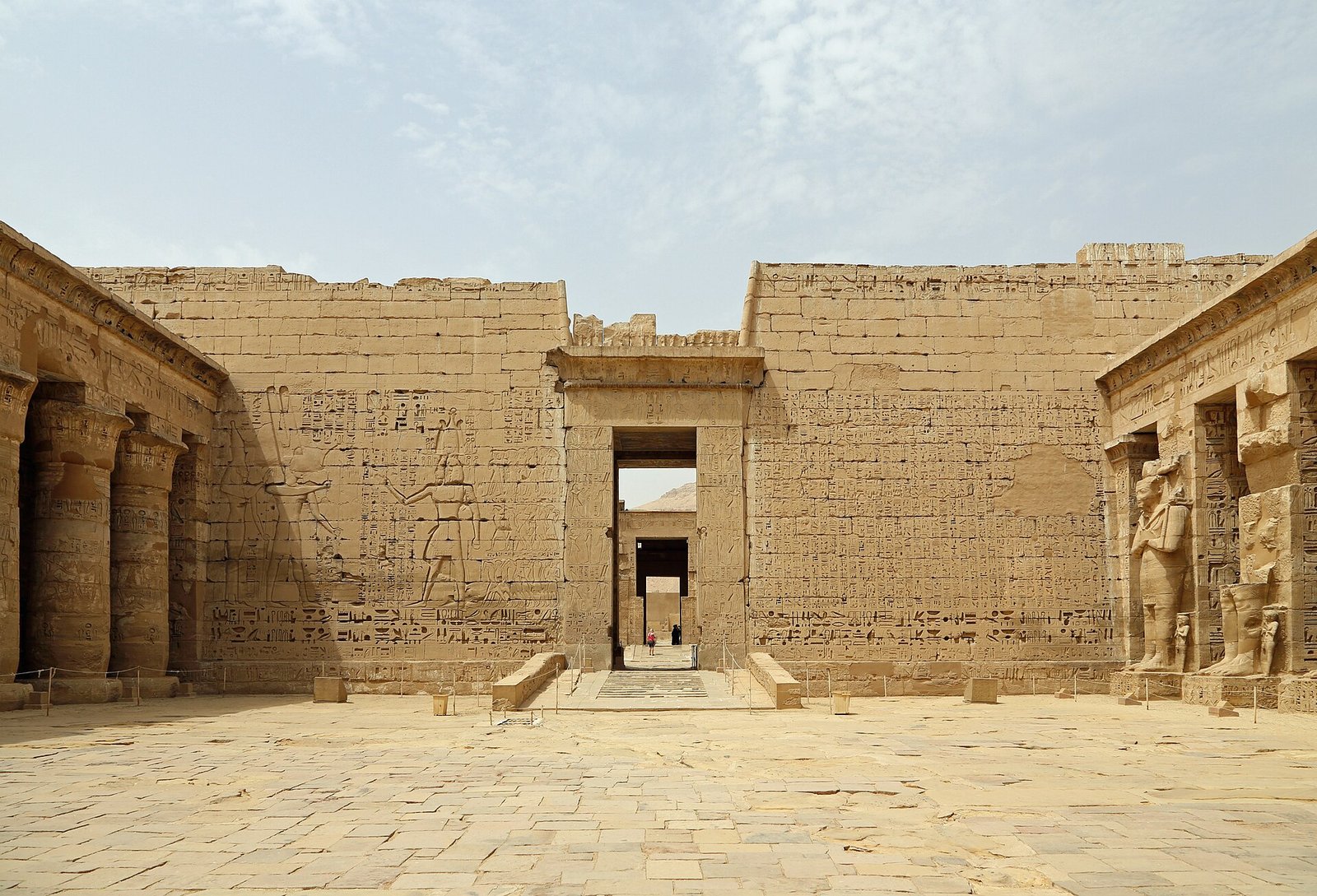
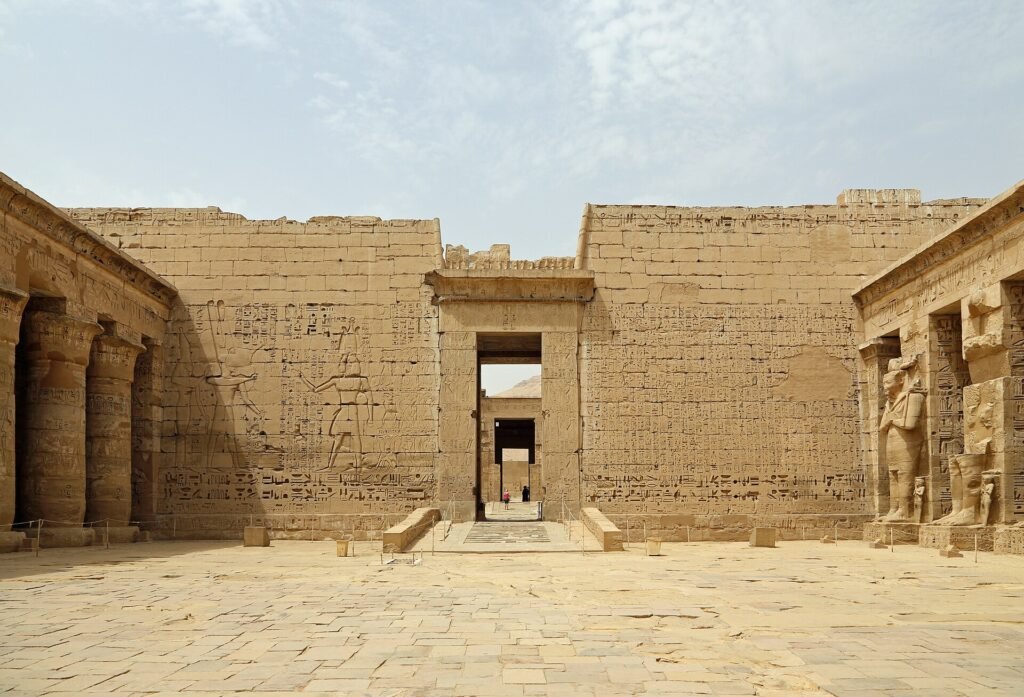
Medinet Habu is the mortuary temple of Ramesses III on the west bank of Luxor, and it is the temple I would send a first-time visitor to before the Ramesseum, and even before Karnak, if they had one hour and wanted to see what an Egyptian temple looked like when it was new. The portico ceilings still carry their original blues, reds and yellows. The outer walls record the battle against the Sea Peoples in more detail than any other source on earth. You walk in through a fortified gate copied from a Syrian fortress, usually with fewer than a dozen other people around you. Plan 90 minutes, go early or late, and pair it with the Valley of the Queens and Deir el Medina, minutes away.
What Medinet Habu is, and why a temple needed a fortress wall
Medinet Habu is the modern name for the site at the southern end of the Theban necropolis. At its heart is the mortuary temple of Ramesses III, the last of the great warrior pharaohs, who ruled in the 20th Dynasty about a century after Ramesses the Great. A mortuary temple was not a tomb. The king was buried in the Valley of the Kings, behind the cliffs to the north. This was where his cult was kept alive with offerings and where he was worshipped alongside Amun.
Ramesses III copied the plan of his hero's temple, the Ramesseum of Ramesses the Great, almost room for room, then wrapped it in a mud-brick wall thick enough to stop an army. Inside stood storerooms, workshops, priests' houses and a royal palace, and rations for the tomb builders of Deir el Medina were paid out from here. When Egypt's grip weakened at the end of the New Kingdom and Libyan raiders came out of the desert, the people of the west bank moved inside. The temple became a town.
The migdol gate, a Syrian fortress rebuilt in stone
You enter from the east through a structure no other temple in Egypt has. The migdol takes its name from a Semitic word for a fortified tower, and Ramesses III built it as a scaled model of the fortresses his armies had besieged in the Levant. Two towers flank a narrow passage, the walls lean inward like a real bastion, and the upper windows show the king receiving lines of prisoners.
The military look is half the story. The upper rooms show the king at leisure among the women of his household, being handed flowers, playing a board game, having his sandals adjusted. It is one of the few places where the private side of a pharaoh is carved on a wall.
Before you go through, study the outer faces of the towers, where Ramesses III smites captives labeled by nation and drawn carefully enough that you can tell a Libyan from a Hittite from a Nubian. Beyond the gate, the first pylon rises more than 200 feet wide, the king in his chariot carved at a scale meant to be read from the canal that once linked the temple to the Nile.
The Sea Peoples battle and the counting of hands
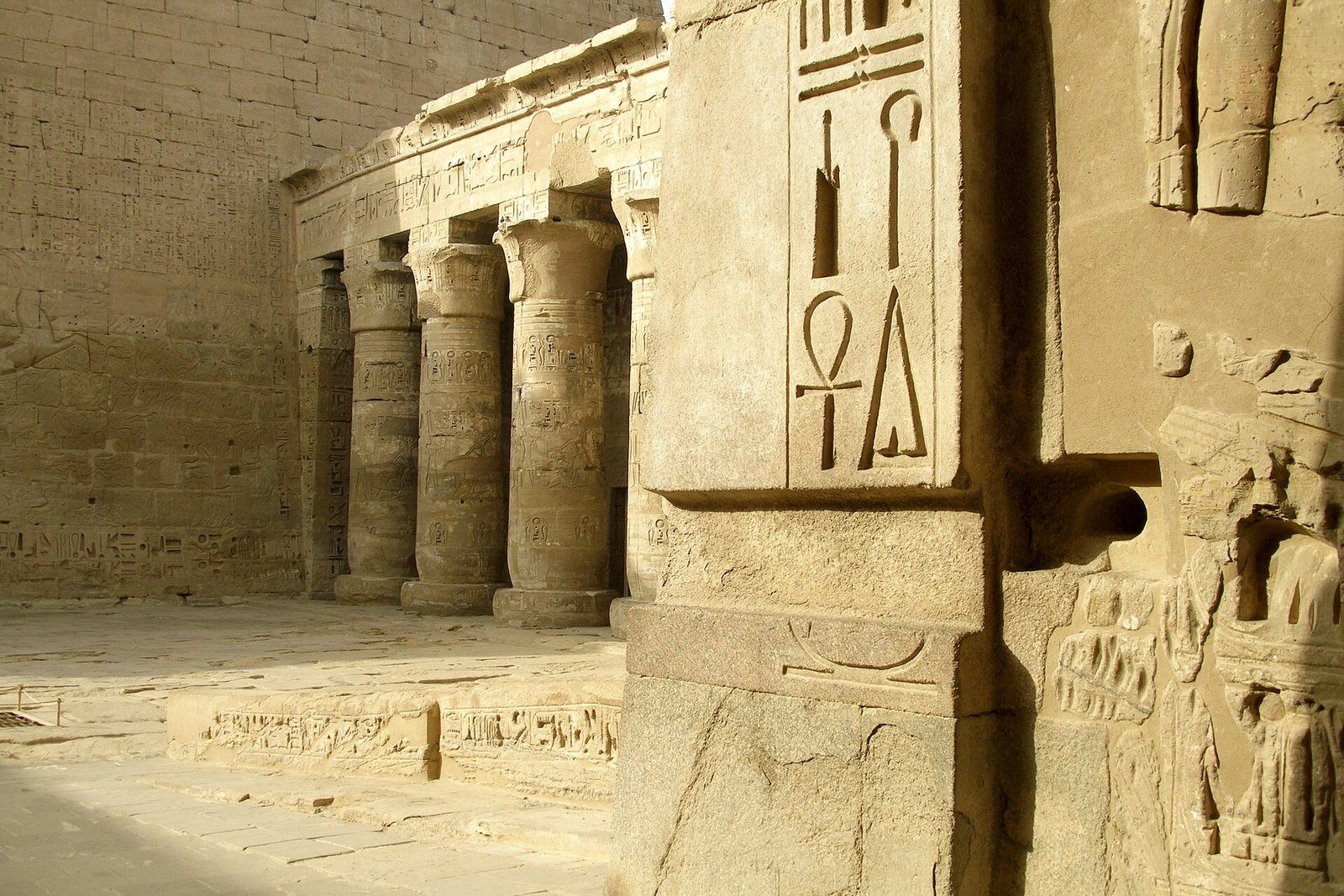
Walk along the outside of the north wall, away from the entrance, and you are looking at the most important historical document of the late Bronze Age. In the eighth year of his reign Ramesses III met a coalition of migrating peoples who had already burned through the Hittite empire, Cyprus and the coastal cities of Syria and Canaan. Egyptian scribes called them the peoples of the sea.
The reliefs show two battles. On land, Egyptian chariots break into a column of ox carts carrying women and children, which tells you this was a migration, not a raid. On the water, in the only detailed picture of a naval battle to survive from the ancient world, Egyptian archers pour arrows into enemy ships that capsize and spill men into the river. The horned helmets and feathered headdresses are precise enough that scholars use them to tell the nations apart.
Then comes the part that stops most visitors. After the victory, scribes count piles of severed hands, and in a separate scene piles of severed genitals, taken from the dead so the tally could not be inflated by counting one man twice. The totals are carved beside the piles. It is grim, bureaucratic and completely authentic. The scenes are cut so deep your fingers fit inside the outlines, and they run along the wall as a sequence. Without someone reading it with you, the ships and the hands blur into one battle.
The first court, the second court and the color that survived
Through the first pylon you enter the first court, which looks like no other courtyard in Egypt because it was also a palace forecourt. On the north side stand pillars fronted by colossal statues of the king as Osiris. On the south side runs a row of papyrus columns with the window of appearances behind them. The reliefs here are the Libyan wars, but your eyes go up: on the architraves and capitals the paint is still there, thick yellow, red ochre, an expensive blue-green, black outlines.
The second court is the reason to visit. It is enclosed on all four sides by covered porticoes, and those porticoes never lost their roofs. Stand under the western colonnade, let your eyes adjust, and look up. The vulture goddess spreads her wings in blue and red across the ceiling. Cartouches, stars and bands of hieroglyphs are painted in colors mixed while Ramesses III was alive. The walls show festivals rather than war, the procession of the god Min on his litter above all.
Why did the color survive here when it has gone from Karnak and the Ramesseum? The porticoes kept their roofs, so the paint sat in shade for thirty centuries. The Coptic town later filled the court with houses and rubble that sealed the lower walls from sun and wind. And the Theban climate is as dry as a climate gets. Beyond the second court the hypostyle halls have lost their roofs and most of their paint.
The window of appearances and the palace behind the wall
In the south wall of the first court is a wide opening framed by carved heads of foreign captives, so that anyone standing in it appeared to be treading on Egypt's enemies. This is the window of appearances. Behind it was the royal palace, a modest mud-brick building with a throne room, a bathroom and a bedroom, whose ground plan has been cleared so you can walk through it.
The window is political theater, and one of the few places in Egypt where you can stand exactly where the audience stood. When the king came to Thebes he sat here to watch wrestling contests in the court and to hand out gold collars of honor to officials who had pleased him. The arrangement, palace on one side of the wall and temple on the other, tells you the king was meant to belong in both worlds at once.
The small temple of the 18th Dynasty and the chapels of the God's Wives
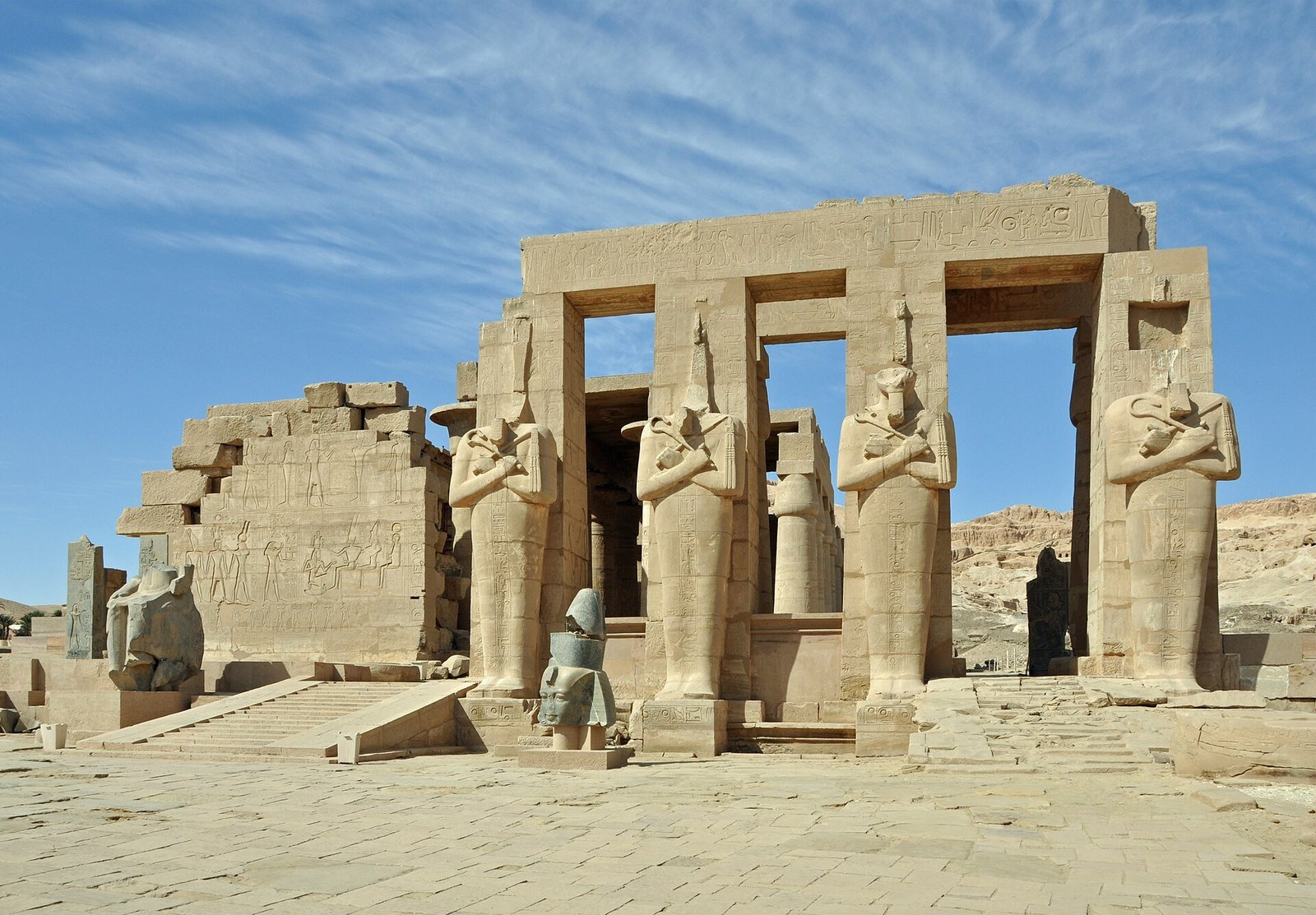
Most visitors walk straight from the migdol to the first pylon and miss the two structures on the north side between them. The first is a compact temple begun by Hatshepsut and completed by Thutmose III, three centuries before Ramesses III. This spot was believed to be the primeval mound where the eight original gods of creation lay buried, which is why a later king put his own temple beside it. Kings kept adding pylons and courts to it into the Roman period.
The second structure, close to the gate, is a row of small vaulted chapels built for the God's Wives of Amun. In the 25th and 26th Dynasties, when kings ruled from far away, real power in Thebes rested with a royal princess installed as Amun's earthly consort. Amenirdis I, Shepenwepet II and Nitocris were buried here, and their chapels hold some of the last finely carved royal reliefs on the west bank.
Djeme, the Coptic town that lived inside the walls
For most of its life Medinet Habu was not a monument. From the late New Kingdom until about the ninth century AD it was a walled town called Djeme, and for the last centuries of that span it was Christian. Houses stood in the courts, a church with columns taken from the temple filled the second court, and several Osiride statues were cut back to make room for it.
The Chicago archaeologists who cleared the site in the 1920s and 1930s removed the town to expose the temple. But the traces remain: some Osiride pillars are stumps, a few columns bear carved crosses, and the outer walls are worn smooth at eye level where houses leaned against them. The rubble of Djeme is a large part of why the paint survived.
Why it is the best preserved and least crowded temple on the west bank
Preservation first. Karnak was rebuilt constantly over two thousand years. The Ramesseum was quarried for stone and partly collapsed. Hatshepsut's temple was reassembled from fragments. Medinet Habu was built in one reign, on one plan, then buried under a town that protected it. The pylons stand to nearly full height, the courts keep their porticoes, and the reliefs run unbroken along hundreds of feet of wall.
Crowds second. The tour buses follow one loop: Valley of the Kings, Hatshepsut's temple, a photo stop at the Colossi of Memnon, back to the boat. Medinet Habu sits at the far southern end of the necropolis and costs an extra twenty minutes that most schedules do not have. On a busy morning you share the second court with a handful of people. In the last hour before closing you may have it to yourself.
The result is the only temple in Luxor with the scale of Karnak, the paint of Dendera and the silence of a tomb chapel in one visit. Our ranking of both banks is in the guide to the Luxor east bank and west bank.
How long it takes, the best light and the practical side
- Time. One hour on your own, 90 minutes with a guide who reads the north wall properly, two hours if you add the small temple, the God's Wives chapels and the palace foundations.
- Best light. The migdol and first pylon face east, so early morning lights them head-on. The painted ceilings show best in indirect light at any hour. The last hour of the afternoon is the finest moment for the north wall, when a low sun rakes across the sunk relief.
- Heat. There is no shade in the first court or along the outer walls. In summer the site passes 100F (38C) before noon, so go at opening or after 3 pm and carry more water than you think you need.
- Photos. Cameras and phones are fine. A small flashlight brings up the ceiling colors under the porticoes.
- Facilities. Ticket office at the gate, a small cafeteria and restrooms by the parking area. Opening hours shift with the season, so check the current times with us.
- Getting there. About fifteen minutes by car from the west bank ferry landing, ten from the Colossi, five from Deir el Medina.
Combining it with the Valley of the Queens and Deir el Medina
Medinet Habu's two closest neighbors are the sites the standard loop also skips. Deir el Medina, the village of the tomb builders, is five minutes up the road, with two of the most beautifully painted tombs on the west bank. The Valley of the Queens is five minutes further, home to the tomb of Nefertari and several fine tombs of princes. The Ramesseum is ten minutes north.
| Plan | Stops in order | Who it suits |
|---|---|---|
| Classic loop plus Medinet Habu | Valley of the Kings, Hatshepsut's temple, Colossi of Memnon, Medinet Habu last | One day on the west bank, first visit |
| The quiet second day | Medinet Habu at opening, Deir el Medina, Valley of the Queens, the Ramesseum | Two days in Luxor, or a second trip to Egypt |
| Afternoon only | Medinet Habu at 3 pm, Deir el Medina, sunset by the Colossi | Cruise passengers with a free afternoon, photographers |
The order matters. Put Medinet Habu last on the classic loop and you arrive as the site empties and the light turns warm. Put it first on the quiet day and you get the cool hour before moving to the tombs, which are underground and comfortable at any hour. If you must cut something, cut the Ramesseum before Medinet Habu: same plan, and this one is intact. The full menu is in our guide to what to see in Luxor.
What a guide adds, and how Explora Egipto slots it in
Medinet Habu is a text, not a view. The reason the temple matters is written in the reliefs, and reliefs do not read themselves. An Egyptologist guide turns the north wall from a jumble of ships into a battle you can follow scene by scene, finds the sandal scene in the migdol, and points to the column where the paint runs unbroken from floor to ceiling. Without that, most visitors leave with photographs of walls they cannot describe.
Explora Egipto is a local agency in Egypt with its own licensed Egyptologist guides and its own vehicles. We build Medinet Habu into the west bank day on request, as the last stop on the classic loop or as the anchor of a quiet second day with Deir el Medina and the Valley of the Queens, and for cruise passengers as a private afternoon excursion while the ship is docked. The options are in our Luxor excursions. Tell us how many days you have and we send you the order of stops and the quote in writing.
Frequently asked questions
Is Medinet Habu worth visiting if I have already seen Karnak and the Valley of the Kings?
Yes, and it is better after them. Karnak shows the scale of a state temple rebuilt over two thousand years. The royal tombs show painted walls underground. Medinet Habu gives you both at once: a complete temple built in a single reign, its porticoes still roofed and painted, with reliefs that tell a story you can follow.
Who were the Sea Peoples, and did Ramesses III really defeat them?
They were a coalition of migrating groups from the Aegean and eastern Mediterranean who moved by land and sea at the end of the Bronze Age, destroying the Hittite empire and cities across Cyprus and the Levant. Ramesses III fought them on land and water in his eighth year and stopped them entering Egypt. Egypt survived where its neighbors did not, though weakened by the effort.
Why does Medinet Habu still have its colors when other temples do not?
Because the porticoes of the courts kept their roofs, so the painted ceilings sat in shade for three thousand years, and because the Coptic town of Djeme filled the courts with houses and rubble that sealed the lower walls from sun and wind. The deep sunk relief held the pigment in place, and the dry Theban climate did the rest. The best color is under the western portico of the second court.
How long do I need at Medinet Habu?
Ninety minutes with a guide is the right figure. That covers the migdol, the north wall in sequence, both courts and the window of appearances without rushing. Add thirty minutes for the small temple of the 18th Dynasty and the chapels of the God's Wives, which sit just inside the gate. One hour is enough for the courts alone, but you will miss the best of the reliefs.
Can I visit Medinet Habu from a Nile cruise?
Yes. Most cruise itineraries give Luxor a full west bank morning and a free afternoon or a second morning, and Medinet Habu is fifteen minutes by car from the cruise dock. We run it as a private afternoon excursion with a guide and driver who collect you at the ship and return you before sailing.
What is the difference between Medinet Habu and the Ramesseum?
The Ramesseum is the mortuary temple of Ramesses II, built about a century earlier, and Medinet Habu was modeled on it by his admirer Ramesses III. The plan is nearly identical. The difference is condition: the Ramesseum was quarried and partly collapsed, and its famous sight today is a fallen colossus, while Medinet Habu stands almost complete with its color and its fortified gate.
See the temple Egypt forgot to strip of its color
Tell us your Luxor dates, whether you arrive by cruise, train or domestic flight, and whether this is your first time on the west bank. We come back with a day that puts you under the painted portico of the second court at the right hour, with an Egyptologist who can read the north wall to you, and the quote in writing.